For forty years, the walls of my home in Setagaya, Tokyo, held the quiet rhythms of a woman living alone. But time has a way of shifting the foundation beneath our feet. After my injury, the old, difficult-to-use facilities of my 46-square-meter apartment began to feel less like a sanctuary and more like a challenge. When my son decided to move in to care for me, I worried if two adults could truly find peace in such a small footprint—nearly 500 square feet of history that needed to become a future.
Our creative journey began with a question of distance: how do we share a life while maintaining that “appropriate distance” necessary for the soul to breathe? Working with architect Kumiko Oi, we embarked on a renovation that was less about knocking down walls and more about reimagining the very concept of space.
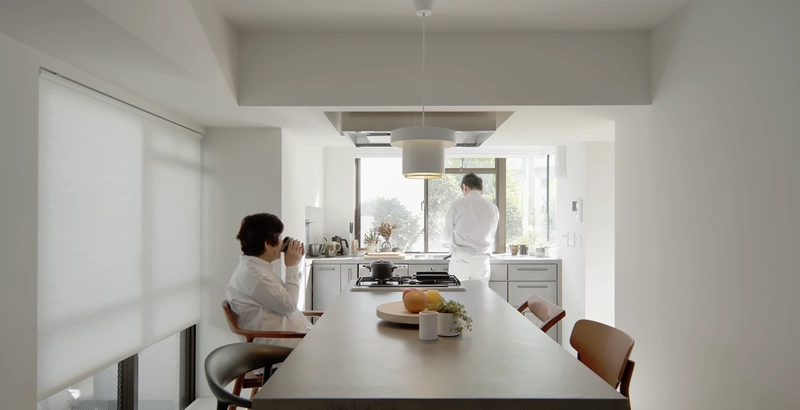
My creative process was rooted in a desire for light and “green space”. I wanted a home that felt “bright and open,” a place where the act of living felt like a daily ceremony. We moved the kitchen to the heart of the home, creating a “lively kitchen environment” where my son, who loves to cook, could serve meals directly from a central island. Now, as I sit by the sink, I look out at the greenery through the window, the chores of the day softened by the view.
The aesthetic of our new home is one of “hidden genius”. To keep the visual landscape “clean,” we designed storage to hide the clutter of modern life—everything from Wi-Fi routers and golf bags to linen and household items. Even the smallest corners, like the toilet and the water closets, were transformed with indirect and sensor lighting so they never feel cramped, but rather comfortable and intentional.
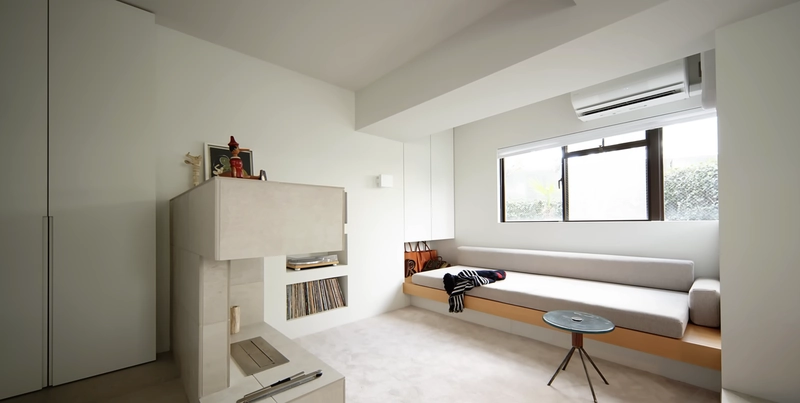
There is a profound emotional depth in how the architecture respects our individualities. My son’s “bedroom” is a masterpiece of multi-purpose design: by day, it is a sunlit living room with a wooden bench; by night, it converts into his bed, with his futon tucked away in hidden storage when guests arrive. To give us privacy, a bio-ethanol fireplace stands as a silent sentinel in front of the entrance, ensuring our living space isn’t immediately visible to the outside world.
The living room itself sits a step lower than the rest of the apartment, carpeted to invite us to sit on the floor and linger. It creates a “separate zone,” a sanctuary within a sanctuary.
From my perspective, this renovation was more than just updating old facilities; it was an act of love. (Note: This emotional reflection is my own narrative interpretation of the source material regarding the mother/son relationship). As Japan’s population ages and more generations choose to live together, I’ve realized that a home doesn’t need to be large to be expansive. It only needs to be designed with the sensitivity to know when to bring people together and when to let them be apart. In this small Setagaya apartment, we didn’t just find more storage; we found a way to live with dignity, side by side.