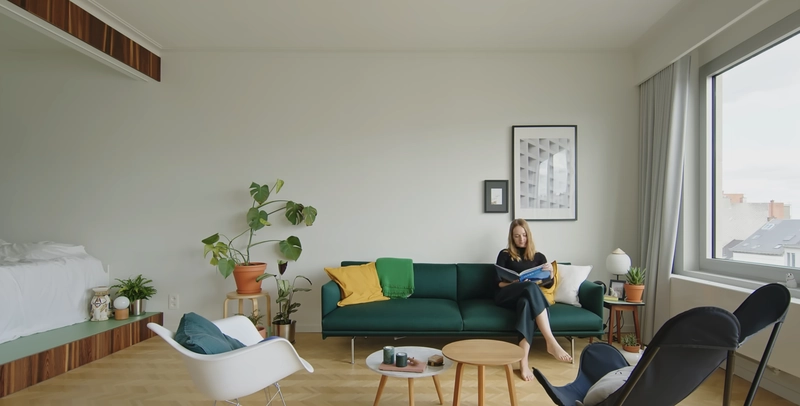
As an architect, I often view the home not just as a shelter, but as a natural sequence of functions and spaces that directly dictate how we live, work, and feel. In an era of rising housing costs, the challenge for modern architecture is to transform limited footprints into fully functioning homes through creativity and spatial efficiency,. By analyzing the design of a 51-square-meter studio in Antwerp, we can see a masterclass in how architecture influences modern living through the strategic use of materials, light, and nature.
Mastering Spatial Efficiency
The core of modern urban living lies in the belief that every centimeter is important. In small-scale architecture, the traditional “separated” floor plan—where every function has its own room—often results in dark, cramped spaces. According to the sources, a more effective modern approach involves removing internal walls to create an open-plan environment.

One of the most insightful techniques used to maximize space is the implementation of a central box. This architectural intervention serves multiple purposes:
• Zoning without walls: By housing the bed and shower within a central structure, the architect can use the exterior of that box as a cabinet system to divide living areas and provide extensive storage.
• Multifunctional furniture: Efficiency is further enhanced when elements serve dual purposes. For instance, a kitchen counter can extend into a seating bench for a dining area, and a dining table can double as a professional workspace.
• Hidden functionality: Modern living thrives on “hidden” features, such as a large mirror that acts as a secret door to a bathroom or pull-out clothing racks that disappear when not in use,.
Materiality and Creative Sustainability
Architecture’s influence on modern life is also felt through the textures and colors we interact with daily. To create a sense of warmth and “home,” architects often combine different materials to add depth to a space. The sources highlight the use of smoked brushed larch for cabinetry, terrazzo worktops for texture, and polyurethane for modern, seamless shower finishes,,.
From my professional perspective, sustainability in modern living isn’t just about high-tech systems; it’s about creative solutions and longevity. This includes:
• DIY and Craftsmanship: Engaging in the physical creation of the space, such as hand-installing a herringbone mosaic parquet floor, allows for high-quality finishes even on a limited budget,.
• Repurposing: Utilizing second-hand components, like a vintage table leg paired with a new top, reduces waste and adds unique character to a modern interior.
The Vital Connection to Nature and Light
Perhaps the most significant influence architecture has on our well-being is its ability to connect us to the natural world, even in a dense city center. In modern design, natural light is treated as a primary material.
To bring light deep into a narrow apartment with only one windowed facade, architects use opaque walls and open layouts to ensure that even interior spaces, like a bathroom, remain bright during the day without the need for artificial lighting,. Furthermore, the relationship between architecture and nature is reinforced by integrating dedicated greenery. Custom shelving designed specifically for plants helps “bring a little bit of nature into the space,” which is essential for maintaining a sense of calm in a compact urban environment,.
In conclusion, architecture influences modern living by proving that limitations can be opportunities. Through a clear floor plan, a thoughtful palette of materials, and a constant dialogue with light and nature, even the smallest space can become a sanctuary that enhances the human experience.