
52 Gel Nail Designs to Try in 2026
Trendy nails don’t fail because they’re ugly. They fail because gel nail designs age fast when they chase hype instead of wearability. What looks stunning on Instagram can feel off after one week of real life, real outfits, and real hands in motion.
Most people assume longevity comes from darker colors or thicker layers. That’s the mistake. Overbuilt gels lift, loud trends date quickly, and copying last year’s chrome-heavy looks is why so many manicures feel stale by month’s end.
2026 rewards smarter choices. Textured finishes, sheer milky tones, refined cat-eye shimmer, and intentional minimalism deliver polish that lasts visually and physically. When technique, trend, and lifestyle align, your nails stop feeling trendy and start feeling timeless.
What Makes Gel Nail Designs Different from Regular Polish?
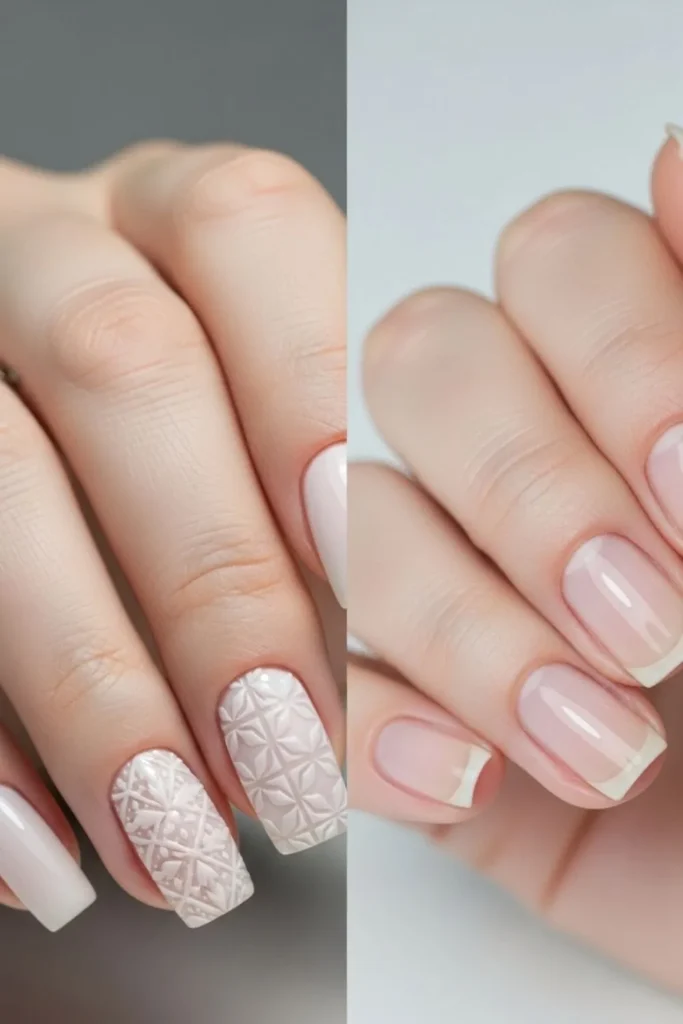
Gel nail designs use UV or LED light to cure polish into a hard, durable finish that resists chipping for 2-3 weeks. Unlike traditional lacquer that air-dries, gel polish bonds directly to your nail plate through a chemical reaction triggered by lamp exposure, creating a glossy surface that maintains its shine throughout wear.
The application process involves three key layers: a base coat that protects your natural nail and ensures adhesion, the color gel that provides pigment and design elements, and a top coat that seals everything with a high-gloss finish. Each layer requires 30-60 seconds of curing time under the lamp.
This layered approach allows nail artists to create complex designs like cat-eye magnetic effects or chrome powder applications that would be impossible with regular polish because each element can be set before adding the next.
The removal process requires acetone soaking rather than simple polish remover. You’ll wrap each nail in acetone-soaked cotton and foil for 10-15 minutes to break down the gel structure before gently pushing off the softened product.
While this takes more effort than wiping off regular polish, the extended wear time and chip-resistant finish make gel designs worth the extra removal step for most people.
See More About : How to Shape Nails: The Complete Guide to Professional-Looking Manicures at Home
How Do Cat-Eye Gel Designs Create That Magnetic Shimmer?
Cat-eye gel polish contains metallic particles that respond to magnetic force, creating a concentrated band of shimmer that shifts as light hits the nail from different angles. The magnet pulls these particles toward its field while the gel is still wet, forming patterns that range from a single curved line to wave effects or full-coverage shimmer depending on how you position the magnet.
The technique requires precise timing and magnet placement. After applying cat-eye gel, you hold the magnet 1-2mm above the nail surface for 3-5 seconds before curing. Different magnet shapes create distinct effects: a bar magnet produces the classic curved line, while stick magnets create sharp diagonal slashes. Some nail artists layer multiple cat-eye colors with different magnet patterns to build dimensional designs that appear to move like liquid metal.
In 2026, cat-eye designs are evolving beyond the chunky metallic look of previous years toward what experts call “liquid light” finer metallic particles that create smoother, more refined shimmer.
This shift toward subtlety makes cat-eye gel polish suitable for professional settings where traditional cat-eye might feel too bold. The effect works especially well when paired with deep bases like burgundy or navy, where the shimmer creates depth rather than competing for attention.
What Are the Most Popular Gel Nail Design Trends for 2026?
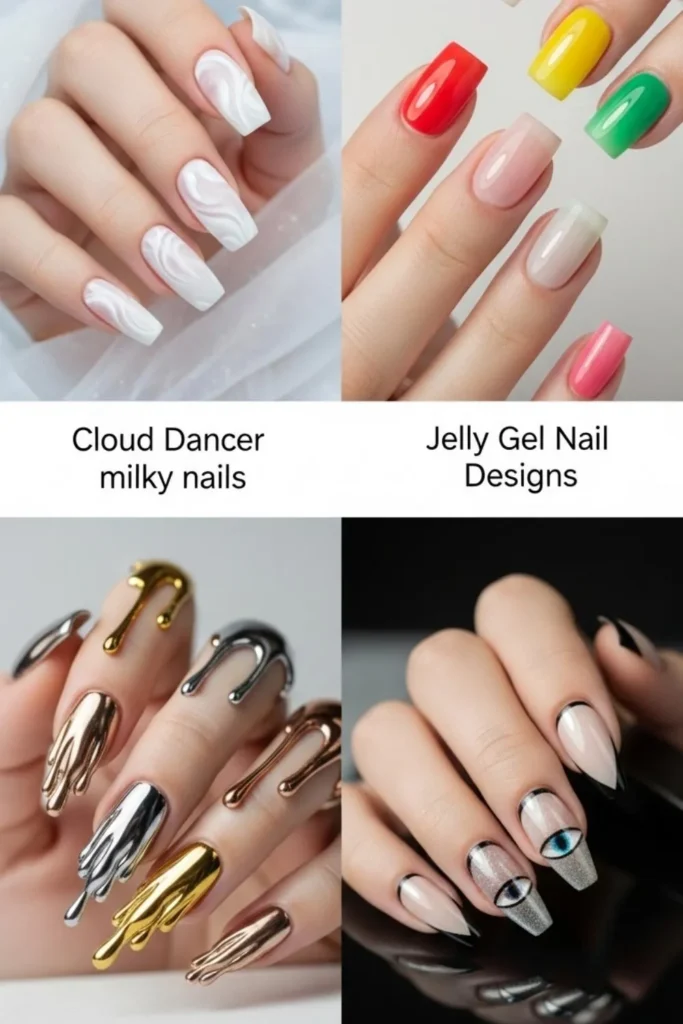
Cloud Dancer dominates 2026 as Pantone’s Color of the Year, replacing last year’s butter yellow with soft, milky whites that feel clean and elevated. This airy shade anchors the rise of creamy white gel manicures, often layered with sheer pearlescent finishes or used as a base for minimal nail art. Unlike stark white polish, Cloud Dancer tones carry subtle warmth that flatters all skin tones while maintaining that fresh, cloud-like appearance.
Jelly nails, also called soap nails, represent the transparent, glossy finish that dominated Korean beauty trends and now defines Western minimalism. These sheer gel shades create a gummy-like effect that feels both playful and refined, with just enough pigment to add subtle color without hiding your natural nail.
The look pairs perfectly with the clean-girl aesthetic that prioritizes healthy, well-maintained nails over heavy coverage. Nail artists achieve this by mixing colored gel with clear top coat or using pre-made jelly formulas that deliver that translucent finish.
Molten metallics continue evolving from chrome’s peak in 2026, but with more sophisticated applications. Gold and silver finishes now appear as liquid-metal accents rather than full-coverage chrome, often combined with embossing gel to create textured, gilded effects that resemble picture frames on individual nails.
The trend leans toward luxurious detailing, think gold leaf fragments or chrome powder applied only to raised 3D elements rather than the all-over metallic looks that defined earlier seasons.
See More About : Black Winter Nails: The Ultimate Guide to Chic, Moody Manicures for Cold Weather
Which Gel Colors Work Best for Short Nails?
Sheer neutrals in milky pink, almond cream, and porcelain tones elongate short nails by creating a seamless extension of your natural nail bed. These translucent shades avoid harsh color breaks that visually shorten the nail, while their light-reflective finishes add subtle dimension.
Gel formulas work particularly well because their glossy cure creates the illusion of length through shine alone.
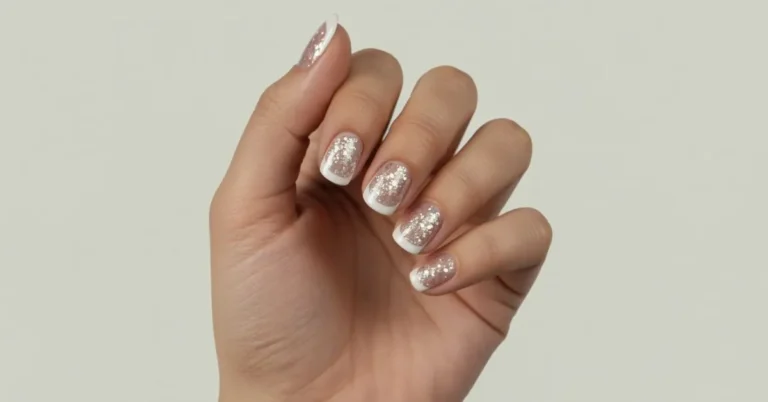
Micro French tips deliver classic elegance without overwhelming limited nail space. The key difference from traditional French manicures lies in the tip width, celebrity manicurists recommend keeping the white line whisper-thin, roughly 1-2mm, to maintain proportion on shorter nails.
This creates clean definition without the chunky appearance that dominated early-2000s French tips. Gel application allows for precision with thin brushes, and the cured finish keeps those delicate lines crisp for weeks.
Geometric micro art offers visual interest through strategic placement rather than coverage. On short nails, a single dot at the base, a slim diagonal stripe, or tiny minimalist shapes on one accent nail creates a focal point without cluttering the limited surface area.
The restraint is what makes the design work choosing placement over quantity lets the art enhance rather than overpower your natural nail shape.
How Long Do Gel Nail Designs Actually Last?
Gel manicures typically maintain their appearance for 2-3 weeks when properly applied and maintained, though longevity depends heavily on your lifestyle and nail health. Office workers who avoid heavy hand use often stretch gel designs to four weeks, while those who frequently wash dishes, garden, or work with their hands may see lifting or dulling around the two-week mark.
The breakdown usually starts at the cuticle line where natural nail growth creates a visible gap, or at the free edge where daily wear causes microscopic chips. Designs with 3D elements, chrome powder, or thick embellishments tend to show wear faster than simple color applications because raised details catch on clothing and surfaces. Regular maintenance moisturizing cuticles daily and avoiding harsh cleaners without gloves extends wear significantly.
Professional removal every 2-3 weeks prevents damage from over-growing gel. Leaving gel on beyond four weeks increases the risk of lifting at edges, which allows moisture underneath and can lead to fungal growth.
The removal timing matters more than the gel itself for nail health proper acetone soaking and gentle removal preserve your natural nail, while picking or peeling gel off causes layers of nail to come away with the product.
What’s the Difference Between Chrome and Cat-Eye Finishes?
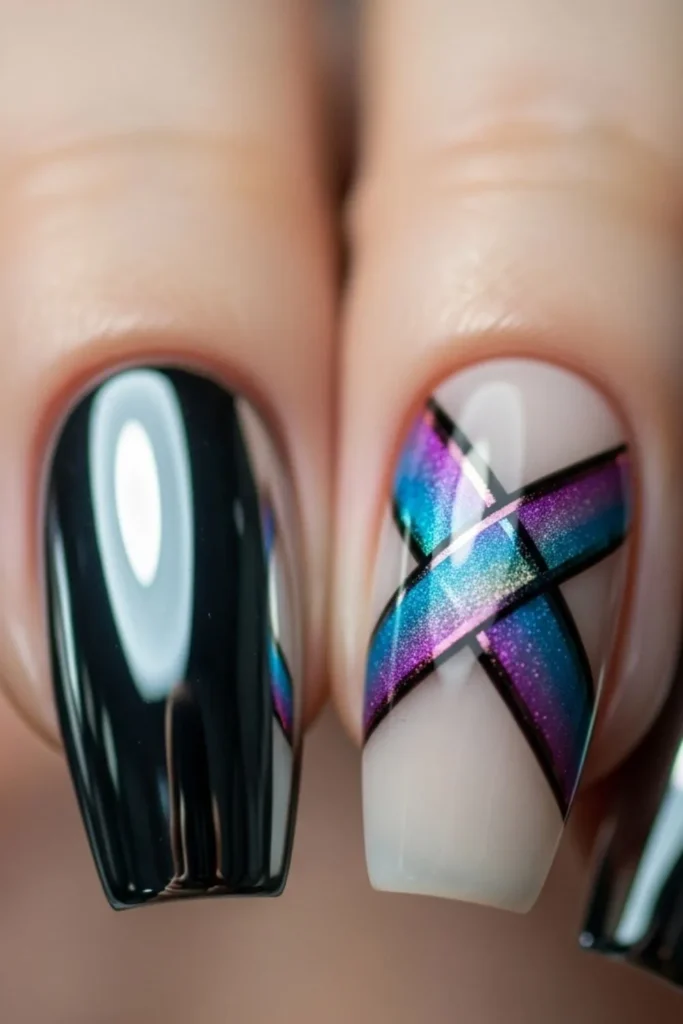
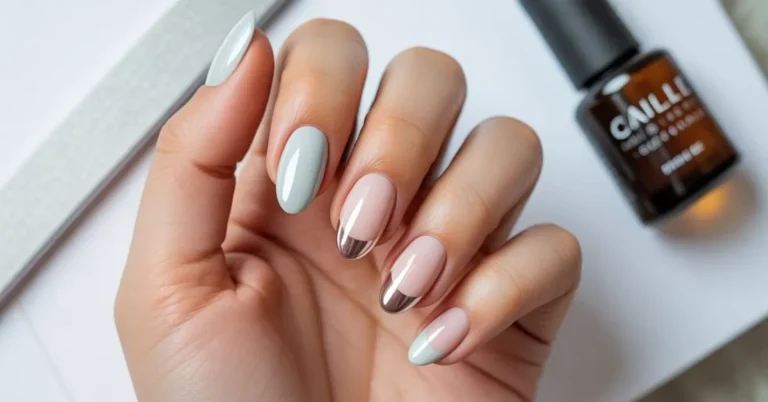
Chrome powder creates a mirror-like reflective surface by rubbing ultra-fine metallic particles into a tacky gel layer, resulting in a uniform, high-shine finish across the entire nail. The application requires a no-wipe top coat as the base after curing, you use a silicone applicator to buff chrome powder into the sticky surface until it transforms into that signature liquid-metal look. The reflection is consistent and smooth, with no pattern or movement.
Cat-eye polish uses magnetic particles suspended in colored gel that respond to magnetic force, creating a concentrated band of shimmer that appears to shift and move as light hits it from different angles.
Unlike chrome’s uniform reflection, cat-eye produces a dimensional line or wave pattern within the color. The effect requires wet gel and magnet contact before curing once cured, the pattern is locked in place but maintains its shifting appearance through the metallic particles’ alignment.
Combining both techniques delivers maximum dimension: apply cat-eye gel, magnetize and cure it, then add chrome powder over specific areas for contrast. This layered approach creates depth impossible with either technique alone.
The cat-eye provides the shifting shimmer base while chrome accents add sharp reflective elements, resulting in designs that photograph beautifully and create visual interest in person through that interplay of movement and mirror finish.
See More About : Christmas Gel Nails: The Ultimate Guide to Festive Manicures That Last
Are Gel Extensions Better Than Acrylics for Nail Art?
Gel extensions offer flexibility and a more natural appearance compared to acrylic’s harder structure, making them ideal for wearers who want length without the rigid feel. The gel cures under LED or UV light in thin, buildable layers that move slightly with your natural nail, reducing the likelihood of cracks or breaks from impact.
This flexibility makes gel extensions particularly suitable for intricate nail art because the surface remains stable without the brittleness that can cause detailed designs to chip.
The application process differs significantly between the two. Gel extensions use pre-formed tips or dual forms as a base, applying gel layers that cure progressively until the desired thickness and length are achieved.
Acrylics mix liquid monomer with powder polymer to create a moldable paste that hardens through air exposure, allowing nail techs to sculpt length and shape freehand. For complex designs, gel’s layer-by-layer approach offers more control; you can cure one element before adding the next, preventing accidental smudging or mixing of colors.
Removal time favors gel extensions, which soak off in 15-20 minutes with acetone wraps versus acrylics’ 30-45 minute removal. However, acrylics provide superior strength for extreme lengths or heavy embellishments because their chemical structure creates a harder surface.
The choice depends on your priority: gel extensions suit those who want natural movement and easier removal, while acrylics work better for maximum durability and structural support for elaborate 3D nail art.
What Makes Ombré Gel Designs So Popular Right Now?
Ombré gel techniques create seamless color transitions that feel modern and dimensional without requiring advanced nail art skills, making them accessible to both professionals and home users.
The gradient effect adds visual interest through subtle shifts in tone rather than stark contrasts, which aligns with 2026’s preference for refined rather than loud designs. Whether blending nude to white for a sophisticated baby boomer French or transitioning between bold neons for summer vibes, the technique adapts to any aesthetic.
The application method uses a makeup sponge or thin brush to blend two or more gel colors while they’re still wet, dabbing or stroking to create the fade before curing. This wet-blend approach works better with gel than traditional polish because gel’s thicker consistency holds the gradient without running or streaking.
You can layer multiple gradients creating depth by curing one fade then adding another on top or keep it simple with a single two-color transition for that classic ombré look.
In 2026, ombré designs appear most frequently in three contexts: French tips with soft nude-to-white fades instead of harsh lines, aura nails where color radiates from the center or edges creating a glowy halo effect, and seasonal color stories like orange-to-coral for summer or plum-to-burgundy for fall.
The versatility makes ombré gel polish relevant year-round, and the technique’s forgiving nature imperfect blends often look intentionally artistic, explaining its staying power as trends shift toward more technical finishes.
How Do You Maintain Gel Nail Designs at Home?
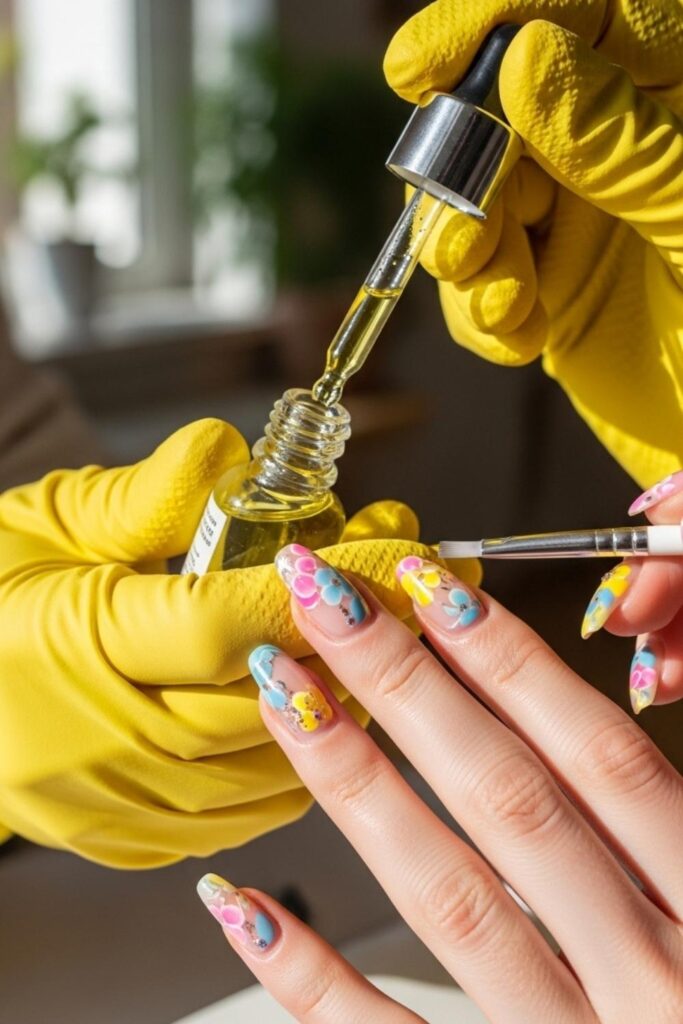
Daily cuticle oil application preserves both gel shine and natural nail health by preventing dryness that leads to lifting at the edges. Apply a drop to each cuticle and gently massage it into the surrounding skin and nail base this keeps the seal between gel and natural nail intact while maintaining flexibility in your nail bed. The oil also prevents that tight, dried-out feeling that develops around week two when natural moisture depletion becomes noticeable.
Wearing gloves during cleaning, dishwashing, or any activity involving prolonged water exposure protects gel designs from premature breakdown. Water seeps into micro-gaps at the cuticle line and free edge, weakening the bond between gel layers and your natural nail.
Harsh cleaners containing bleach or ammonia accelerate this process by chemically degrading the gel surface. Taking 30 seconds to pull on gloves before tackling household tasks can extend your manicure by a full week.
Refreshing the top coat every 4-5 days restores shine and seals minor surface wear before it becomes visible damage. Use a thin layer of gel top coat over the existing design, cure for 60 seconds, then wipe away the tacky layer.
This maintenance step costs less than $2 per manicure but makes the difference between a gel design that looks fresh for three weeks versus one that appears dull and worn after ten days. The new top coat layer fills microscopic scratches from daily wear and reinforces the seal at vulnerable edges.
See More About : Christmas Gel Nails: The Ultimate Guide to Festive Manicures That Last
What Are the Best Gel Nail Shapes for Different Hand Types?
Almond nails elongate shorter fingers through their tapered point while maintaining enough width at the base to provide structural strength, making them the most universally flattering shape.
The gentle curve from sidewall to tip creates a feminine silhouette that works equally well for minimalist designs and elaborate nail art. For gel applications, almond shapes cure evenly because the gradual taper distributes stress across the nail structure rather than concentrating it at sharp corners.
Square and squoval shapes suit wider nail beds by emphasizing the nail’s natural width rather than fighting against it. The straight free edge of square nails provides maximum surface area for designs particularly useful for geometric patterns or detailed art that needs space to breathe.
Squoval (square with rounded corners) offers the same benefits with less likelihood of corner breaks, since the softened edges eliminate the stress points where cracks typically start. These shapes work best on medium to long nails where the width-to-length ratio prevents a stubby appearance.
Stiletto and coffin shapes create dramatic length but require either strong natural nails or gel extensions to maintain their extreme tapers. The pointed stiletto concentrates stress at the tip, making it prone to breakage unless reinforced with builder gel or hard gel overlays.
Coffin (also called ballerina) distributes weight more evenly with its flat tip but still demands length to achieve the characteristic tapered-then-squared silhouette. Both shapes provide ample canvas for bold designs and work particularly well with ombré techniques that benefit from extended length to showcase the full gradient.
Which Minimalist Gel Designs Look Professional?
Sheer pink or nude washes create the “your nails but better” effect that defines professional minimalism, enhancing your natural nail color rather than covering it. These translucent gels often in shades like milky rose, almond cream, or soft beige add just enough color to even out discoloration while maintaining the appearance of bare nails.
The gel formula provides structural support and high shine that regular polish can’t match, making nails look healthy and well-maintained without obvious polish.
Micro French manicures with whisper-thin white tips deliver classic elegance in a modern proportion, avoiding the thick, obvious French tips that can read as dated in corporate environments.
The key lies in the line width: 1-2mm creates definition without demanding attention. Using gel allows for precision application with fine brushes, and the cured finish keeps those delicate lines crisp through presentations, typing, and handshakes. A glazed or pearl top coat over the design adds subtle dimension while maintaining the understated aesthetic.
Single accent nails with minimal detail, a delicate line, small dot, or thin metallic stripe provide visual interest while respecting workplace norms around conservative appearance. Placing the accent on the ring finger feels intentional rather than incomplete, and limiting embellishment to one nail per hand keeps the overall look restrained.
Gel application ensures these small details don’t chip or fade throughout the workweek, maintaining that polished appearance that traditional polish loses by day three.
What Nail Art Techniques Work Best with Gel Polish?
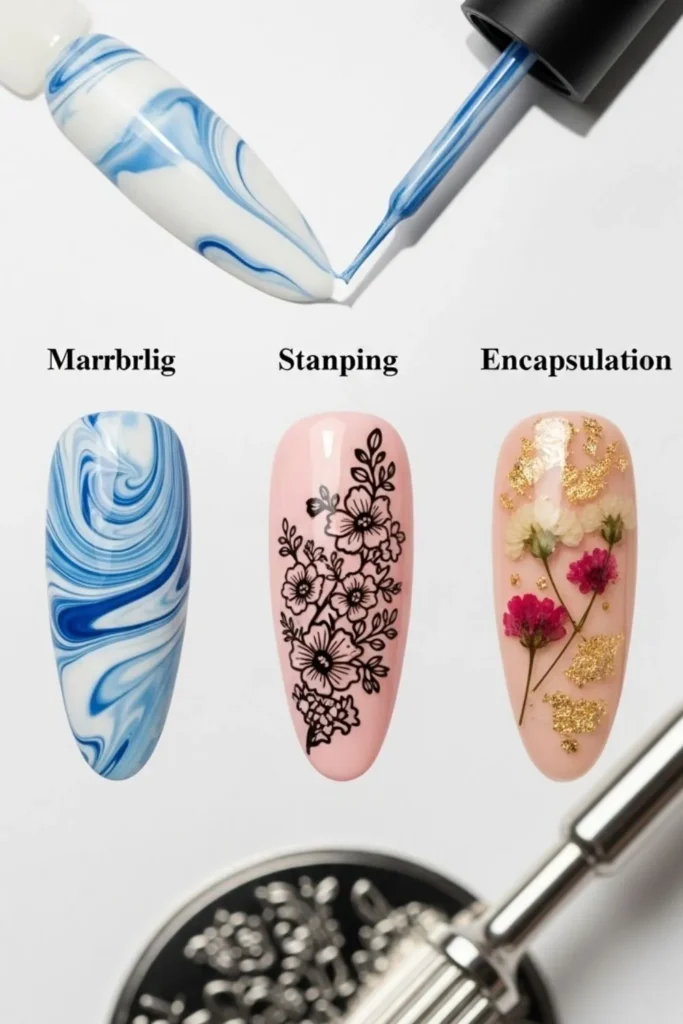
Marbling creates organic, flowing patterns by swirling multiple gel colors together while wet, then curing the design to lock in those abstract veins and color blends. The technique works exceptionally well with gel because the thicker consistency holds pattern definition without bleeding together like traditional polish.
Using a thin brush or dotting tool, you can create deliberate marble veins by dragging through wet gel colors, or achieve random patterns by dabbing colors together and letting them naturally intermingle before cure.
Stamping transfers intricate designs from etched metal plates onto your nails using a silicone stamper and special stamping gel that grabs detail without smearing. The process requires practice but delivers professional-looking patterns, florals, geometric shapes, lace effects in seconds.
Gel stamping formulas stay workable long enough to complete the transfer but cure quickly once exposed to the lamp, making them ideal for creating detailed accent nails within a minimalist manicure. The stamped design gets sealed under gel top coat, protecting those fine details from wear.
Encapsulation embeds elements like dried flowers, glitter, or foil fragments between gel layers, creating dimensional designs that remain smooth to the touch. You cure a base gel layer, place your chosen elements on the surface, then apply a thick layer of clear gel over top to seal everything flush with the nail.
This technique allows for creative expression of pressed flowers for spring, metallic flakes for festive nails, tiny pearls for bridal designs while maintaining the smooth finish that gel provides. The encapsulated elements can’t catch on clothing or chip away because they’re locked between cured layers.
See More About : Stunning Green Winter Nails: 50+ Ideas to Elevate Your Cold-Weather Style
How Do Seasonal Trends Affect Gel Nail Design Choices?
Spring 2026 emphasizes floral elements and soft pastels, with delicate flower accents ranging from minimalist single blooms to full garden designs. Jelly nail formulas in lilac, mint, and peach tones deliver that fresh, seasonal feel while maintaining the translucent quality that defines clean-girl minimalism.
Pearl finishes that shift subtly in natural light feel particularly spring-appropriate, adding dimension without the heavy metallics of winter months. The season favors shorter nail lengths and rounder shapes that align with the softer, more romantic aesthetic.
Summer shifts toward vibrant neons and bold color blocking, with orange ombré nails and electric color transitions defining the warm-weather palette. Jelly gels in bright aqua, coral, and lime create that sun-soaked, festival-ready energy when applied in gradient techniques or paired with gold foil accents.
Beach-inspired designs like subtle wave patterns or iridescent chrome that mimics sea glass become relevant, while longer nail shapes return to accommodate the bolder designs that summer occasions allow.
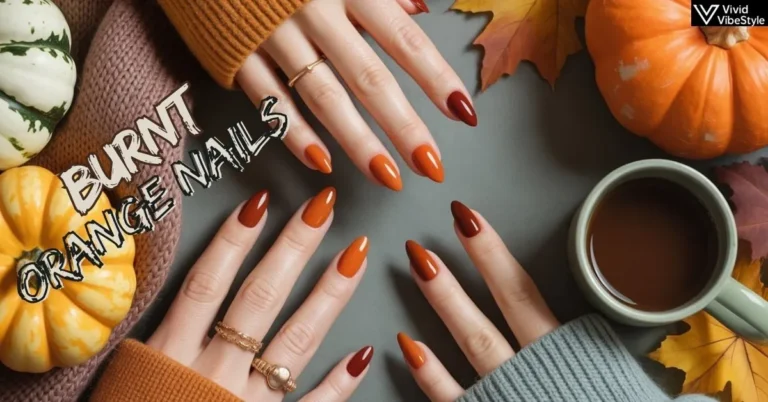
Fall and winter bring moody, sultry tones with deep burgundies, forest greens, and black cherry shades replacing summer’s brightness. Cat-eye designs gain prominence in these darker bases where the magnetic shimmer creates dramatic depth, often layered with chrome accents or matte top coats for textural contrast.
The season also sees increased demand for 3D elements, textured finishes, and embellishments as holiday events justify more elaborate nail art. Pantone’s Cloud Dancer white remains relevant as a winter neutral, often paired with silver accents or used in reverse French designs for festive sophistication.
What’s the Proper Way to Remove Gel Nail Designs?
Filing the top layer breaks the seal and allows acetone to penetrate the gel structure more effectively, reducing soak time and preventing damage to your natural nail. Use a medium-grit file (180-240 grit) to gently buff away the shiny top coat and color layer, being careful not to file into your natural nail.
This step is especially important for designs with thick builder gel, chrome powder, or 3D elements that create extra layers the more you remove through filing, the faster and easier the acetone soak becomes.
Wrapping each nail in acetone-soaked cotton and aluminum foil creates the sealed environment necessary for gel breakdown, maintaining acetone contact while preventing evaporation.
Cut cotton pads into nail-sized pieces, saturate them with pure acetone (not regular nail polish remover), place them on each nail, then wrap tightly with foil. The 10-15 minute soak time softens gel to a rubbery consistency that pushes off easily with a wooden cuticle pusher or orangewood stick forcing removal before gel has fully softened causing layers of your natural nail to peel away.
Moisturizing immediately after removal restores hydration that acetone depletes from both nails and surrounding skin. Apply cuticle oil generously to each nail and massage into the nail bed, cuticles, and skin.
Follow with hand cream to seal in moisture. Your nails will feel thin and flexible after gel removal, this is normal and temporary. Allowing 3-7 days between gel applications gives nails time to rehydrate and rebuild their natural structure, preventing the progressive thinning that comes from continuous back-to-back gel wear without breaks.
Which Gel Brands Offer the Best Color Selection for 2026 Trends?
OPI GelColor delivers extensive shade ranges that align with current minimalist and metallic trends, including their soft pink and nude collections that define clean-girl aesthetics. Their formulas cure consistently across different lamp types and provide true color payoff in 1-2 coats, making them reliable for both salon professionals and home users.
The brand updates seasonal collections to reflect trend forecasts, with recent launches focusing on sheer jellies, pearlescent finishes, and muted neutrals that dominate 2026 design preferences.
CND Shellac pioneered gel polish technology and maintains strong formulations particularly suited for natural nail overlays and minimalist designs. Their shade selection emphasizes wearable neutrals and classic colors over trendy brights, making them ideal for professional settings and timeless looks.
Shellac’s removal process is gentler than standard gel systems because the formula lifts more easily with acetone wraps, preserving natural nail health through repeated applications important for anyone maintaining continuous gel wear.
Beetles and Kiara Sky cater to nail art enthusiasts with specialized formulas including magnetic cat-eye gels, chrome-compatible no-wipe top coats, and builder gels for extensions.
These brands release frequent trend-driven collections of neon jellies, milk bath neutrals, metallic finishes at accessible price points that encourage experimentation. Their formulas work well for layering techniques, stamping, and encapsulation designs because they maintain workable consistency without running or self-leveling excessively before cure.
See More About : Christmas Gel Nails for Short Nails: Festive Designs That Make a Big Statement
What Role Does Nail Shape Play in Gel Design Success?
Nail shape determines how light reflects off gel finishes, directly impacting how chrome, shimmer, and gradient designs appear on your hands. Almond and oval shapes create continuous curves that allow chrome powder to reflect light smoothly, maximizing that mirror effect across the entire nail surface.
Square and coffin shapes produce sharp angles where light hits differently, creating visual breaks that work well for geometric designs but can interrupt the seamless flow of ombré or aurora effects.
The free edge length and shape affect design proportion and structural integrity in gel applications. Longer lengths provide more canvas for detailed art like marble effects or floral designs, but they also increase stress on the gel structure particularly at corners for square shapes or tips for stiletto nails.
Builder gel reinforcement becomes essential beyond a certain length to prevent flexing that causes color gel to crack. Shorter nails limit design real estate but cure more evenly because the gel layer distributes uniformly across a smaller surface area.
Shape choice influences which designs flatter your hand proportions rather than fighting them. Wide nail beds benefit from vertical elements thin metallic stripes, vertical gradients, or almond shapes that create the illusion of length.
Narrow nail beds can handle bolder patterns and horizontal elements without appearing stubby. Understanding your natural nail shape and choosing gel designs that complement rather than contradict those proportions makes the difference between a manicure that enhances your hands and one that draws attention to aspects you’d prefer to minimize.
How Do Professional Results Differ from DIY Gel Applications?
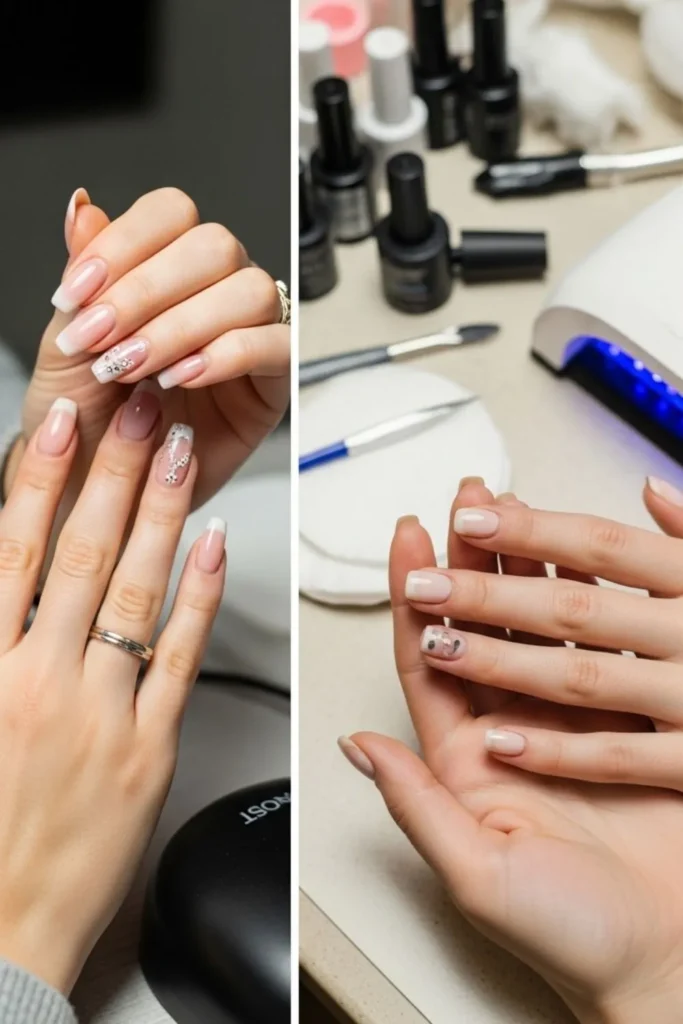
Professional nail preparation includes thorough cuticle work, precise nail surface buffing, and dehydration steps that home users often skip, creating the foundation for gel adhesion that lasts the full 2-3 weeks.
Nail techs push cuticles cleanly without leaving skin on the nail plate, buff the natural nail to remove oils and create texture for bonding, then apply dehydrator or pH balancer to ensure the nail surface accepts gel optimally.
These preparation steps often taking 15-20 minutes before any gel touches the nail determines whether your manicure lasts three weeks or lifts within five days.
Application technique separates professional results from amateur attempts, particularly in avoiding gel on skin and achieving even coverage without thick, uneven layers.
Professionals know to leave a microscopic gap between gel and cuticle line (called the “margin of error”) that prevents lifting as nails grow, while home users often flood the cuticle trying to get close coverage.
Layer thickness matters too thin, evenly distributed coats cure properly and resist cracking, while thick globs remain tacky in the center or cause premature peeling as the top and bottom layers cure at different rates.
Product quality and proper curing equipment make the difference between gel that stays glossy for weeks and gel that dulls within days. Professional-grade gel formulas contain higher concentrations of photoinitiators (the chemicals that respond to UV/LED light), ensuring complete cure even in thick layers or dark colors.
Salon lamps provide consistent wattage across all bulbs and cure spectrum, while cheaper home lamps often have dead spots or insufficient power that leave gel partially uncured resulting in tacky surfaces, premature wear, or allergic reactions from uncured product touching skin repeatedly.
See More About : Sagittarius Nails: Bold Designs for the Adventurous Fire Sign
What Are the Most Common Gel Nail Design Mistakes to Avoid?
Skipping base coat or rushing nail preparation causes the most frequent gel failures, with lifting at edges or complete pop-off within days rather than weeks. The base coat creates the chemical bond between your natural nail and colored gel without it, you’re relying on surface adhesion alone, which fails the moment moisture gets underneath.
Proper prep means dehydrated, buffed nails free of oils and dead cuticle skin. Applying gel over moisturized nails or skipping the buffing step sets your manicure up for immediate failure regardless of application technique.
Applying gel too thickly prevents complete curing and creates a soft layer between the fully cured top and bottom, leading to premature chipping and an inconsistent finish. Each gel layer should be thin enough to see through slightly you build opacity through multiple thin coats rather than one thick application. Thick gel stays tacky in the center even after lamp exposure because UV/LED light penetrates only so deep before the photoinitiators consume all available light energy. This uncured middle layer flexes and breaks down, causing the color coat to separate from the base.
Peeling or picking at lifting gel removes layers of your natural nail along with the product, creating thin spots and weakness that take months to grow out. When you notice lifting at edges often appearing as a white line where gel separates from the nail the correct response is professional removal or proper acetone soaking, not picking.
Each time you peel gel, you remove approximately 3-5 layers of nail cells, progressively thinning your nails until they become flexible, prone to breakage, and painful. The temptation is real, but those few seconds of peeling satisfaction create months of nail damage.
How Can You Customize Pre-Made Gel Designs?
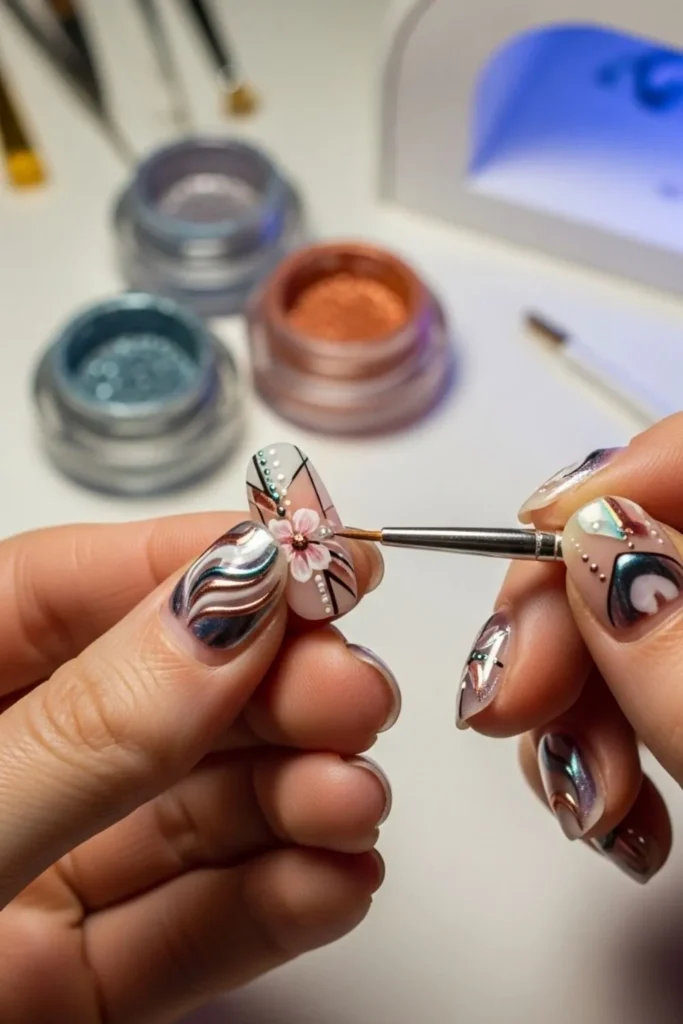
Adding hand-painted accents over cured gel designs personalizes pre-made looks without requiring advanced nail art skills, using thin brushes to add dots, lines, or small shapes in contrasting colors.
After curing your base design whether a simple nude or an ombré you can use detail brushes to paint delicate flowers, geometric accents, or minimalist line work before sealing with top coat. The key is keeping additions minimal and intentional rather than covering the entire base, which maintains the clean aesthetic while making the design uniquely yours.
Layering different finishes transforms basic gel manicures into multi-dimensional designs through selective application of matte, glossy, or textured top coats. Applying matte top coat to all nails except the ring finger creates contrast, or using glossy coat everywhere except tips produces a reverse French effect.
Chrome powder can be rubbed into only portions of the nail tips, cuticle area, or geometric sections rather than full coverage. This selective finishing allows you to create custom looks from standard gel colors by manipulating the final surface treatment.
Mixing gel colors directly on a palette or nail surface generates custom shades that aren’t available in pre-bottled formulas, letting you match specific outfits, events, or aesthetic preferences.
Blend small amounts of gel polish with a thin brush or toothpick, testing the shade on a practice nail or palette before applying. You can lighten dark shades with white gel, warm cool tones with a drop of coral, or create entirely new colors by mixing complementary shades.
This technique works best with gels from the same brand because different formulas cure at varying rates, and mixing incompatible gels can result in incomplete curing or separation.
See More About : Nail Designs for Kids: Safe, Fun Ideas Parents Love in 2025
What Makes Certain Gel Designs More Instagram-Worthy?
Contrast between elements whether through color, texture, or finish creates visual interest that photographs well and catches attention while scrolling. Designs that pair matte and glossy finishes on the same nail, combine chrome accents with soft bases, or layer 3D elements over smooth color produce depth that translates to camera.
Flat, monochromatic looks often disappear in photos regardless of how elegant they appear in person, while designs that create shadows, reflections, or dimension remain visually engaging through the lens.
Proper lighting during photography dramatically affects how gel finishes appear, with natural indirect light showcasing shimmer and chrome better than harsh overhead or direct sunlight.
Cat-eye and magnetic designs need movement to display their shifting effect capturing photos from multiple angles shows the pattern transformation that makes these finishes special.
Chrome and metallic finishes photograph best with light sources at 45-degree angles, creating reflections without washing out the entire nail surface. Understanding how light interacts with different gel finishes helps you position hands during photos to maximize each design’s signature effect.
Negative space and strategic minimalism often perform better on social media than busy, over-designed nails because they provide visual breathing room that reads clearly on small screens.
Designs with one or two focal points an accent nail with detailed art while others remain nude, or a bold French tip on an otherwise minimal manicure direct viewer attention intentionally.
Overly complex designs with multiple patterns, colors, and techniques competing for attention can look muddy in photos, while thoughtfully composed designs with clear concepts translate effectively across platforms regardless of image size.
Frequently Asked Questions
How much do professional gel nail designs typically cost?
Professional gel nail designs in the U.S. usually cost between $45 and $90, depending on the salon, design complexity, and location. Simple gel designs are cheaper, while detailed nail art and extensions increase the price.
Can you apply gel nail designs over damaged or weak nails?
Yes, gel nail designs can be applied over weak nails, but damaged nails should be treated first to prevent further breakage. Many nail techs recommend a strengthening base coat or short gel overlay for added protection.
What’s the difference between UV and LED lamps for curing gel?
UV lamps cure all types of gel polish but take longer, usually 2 minutes per layer. LED lamps cure faster in 30–60 seconds and last longer, but they only work with LED-compatible gels.
How do you prevent gel nails from yellowing over time?
Avoid excessive sun exposure, tanning beds, and smoking, as UV light and chemicals cause gel nails to yellow. Using a high-quality top coat and wearing gloves for cleaning also helps keep gel nail designs clear.
Are gel nail designs safe during pregnancy?
Gel nail designs are generally safe during pregnancy when done in a well-ventilated salon to reduce fume exposure. Many pregnant clients in the U.S. choose “3-free” or low-odor gel formulas for extra peace of mind.
Can you exercise or swim immediately after getting gel nails?
Yes, you can exercise or swim right after getting gel nails because gel polish is fully cured under the lamp. Just avoid very hot water for a few hours to protect the cuticles and seal.
Key Takeaways
- Gel nail designs use UV or LED curing to create durable, chip-resistant finishes that last 2-3 weeks, with application involving layered base coat, color, and top coat that bond through light exposure.
- Cat-eye gel polish contains magnetic particles that create shifting shimmer patterns when a magnet is held above wet gel, with 2026 trends favoring finer particles for “liquid light” effects rather than chunky metallics.
- Popular 2026 trends include Cloud Dancer milky whites inspired by Pantone’s Color of the Year, transparent jelly nails for clean-girl aesthetics, and sophisticated molten metallics used as accents rather than full coverage.
- Proper maintenance requires daily cuticle oil, wearing gloves during water exposure, and refreshing top coat every 4-5 days to extend wear and preserve shine.
- Professional gel removal involves filing the top layer, soaking with acetone-wrapped cotton for 10-15 minutes, and immediately moisturizing to restore hydration, with 3-7 day breaks recommended between applications for nail health.
Conclusion
Gel nail designs deliver lasting wear and professional polish that traditional lacquer can’t match, with the 2026 landscape favoring refined minimalism over loud statements. The shift toward sheer jellies, liquid-light cat-eye finishes, and strategic chrome accents reflects a broader movement toward designs that enhance rather than overpower your natural aesthetic.
Whether you’re drawn to Cloud Dancer whites for their clean sophistication or magnetic shimmers for dimensional interest, success comes from matching techniques to your lifestyle and maintaining proper application practices.
The techniques that define this year from micro French tips that elongate short nails to encapsulated florals that capture spring’s energy offer options for every skill level and occasion.
Understanding how different finishes photograph, which shapes flatter your hand proportions, and when to choose gel extensions over natural nail overlays helps you make informed decisions that deliver results you’ll actually wear for the full 2-3 weeks.
Your gel nail designs should work with your daily routine, not complicate it, while still delivering that polished finish that makes the investment worthwhile.